I think it's often easy to overlook how unbelievably vast the internet is. It's one thing to read the number of pages Wikipedia has, or hear how many hours of video is uploaded to YouTube every second, but I don't think anyone can actually comprehend how much content is stored across the world at this point.
This is compounded by the fact that at this point, my internet browsing habits are pretty circular. I check my emails and Facebook, read through the webcomics I like, look for updates on blogs I follow, browse Reddit's main page and the subreddits I actually care about (Starcraft, Gaming(news), RPG, Warhammer), etc. I even have almost a routine of websites I tab through when first logging on my computer every day.
Even though I visit a lot of websites through Reddit, I wouldn't really consider that finding new territory. It's easy to see the internet as consisting of a lot of content I purely don't care about (celebrity news gossip anyone?) or pages that I glance at for one second before moving on and never looking back (hello image memes).
Therefore it's always a very nice surprise when I actually find a website that I end up returning to and browsing much of the content, and I had just such a surprise the other day. A friend has recently started up a website where she blogs about reading A Game of Thrones and that she drew the inspiration from two of her favorite blogs, Mark Reads and Mark Watches. I was very much intrigued by the GoT project; I had just recently finished reading the series and expressing my reactions to a friend, and then turned around and talked to another friend as he started the same journey. I was very curious what another person would think of what I consider a fantastic series. Out of curiosity, I clicked through to the websites that inspired this venture, not suspecting that I would spend the majority of two days reading the content there. (Also, forward apologies for no pictures in this post)
Showing posts with label Internet. Show all posts
Showing posts with label Internet. Show all posts
Sunday, July 3, 2011

Thursday, July 22, 2010
More like a Ripple: On Google Wave
So yesterday for some random reason I thought of Google Wave. What's that, you ask?
I'm guessing some of you had similar experiences with the product, and I logged into today for the first time in probably more than half a year (if not a lot more) just because I was thinking of writing this blog post. However, rather than analyze the product itself, I'd rather post my thoughts on why, unlike many other Google products, Wave seems to have made itself defunct almost at the start (much like the PSP Go)
To put it short, I think Google itself made Wave unnecessary by making its other programs as good if not better.
To preface this point a little, I have to confess that I never actually used Wave. Not a single Wave sent or received, but I think that's indicative of the problem: I never thought of a situation where I went "oh hey, I should try out Wave finally." I was part of the whole invites getting passed around, and could have given out more of my own, but everyone who was interested already had it, or many people simply didn't know what it was. But as stated, even with people I knew who had it, I never had a reason to use it.
The first big feature I remember being advertised is moving email more towards an IM service. The first problem with that is trying to eliminate IMs; I use a couple IM services, and I don't need to add another. The second and bigger problem is that Gmail already does act like a delayed IM service with it's awesome grouping feature. For instance, I have a 70-email long group regarding the Dark Heresy campaign. With any other email server that'd be a mess, but Gmail nicely groups them together, which is basically what Wave was offering. So number one reason why to use Wave made useless.
The second feature was sort of the overall purpose of Wave, that being group collaboration. But again, I feel that the Google Docs suite trumps this. For instance, the most common group project I do relies on Powerpoints, often with face-to-face meetings (being in college and all). Even when not together, as stated before Gmail works perfectly well to exchange ideas. But with something like a Powerpoint, the Google Docs version works wonders. I've used it a handful of times prepping presentations with a group, and the simultaneous edit and universal accessibility means no messing emailing of files and the like. It's a presentation that everyone in the group always sees the most current version of and can edit in real-time on their own computers. I'm not sure how you can get much more advanced on that front.
So yes, Wave seems to offer all these features but more cleanly, and with a more unified front, but the problem is getting people to use a different program just for that purpose when they already have things they like. People use Gmail for all their email needs oftentimes, not just group collaboration, and people oftentimes use the other Google Docs apps, even often for single projects. Wave is simply, while apparently a very nice program, too specialized. The easiest way I can see to make Wave relevent would be to incorporate Wave into Gmail, much like Google Docs are (amongst other programs). I honestly don't even understand why they didn't just do it in the first place. A good point here is Buzz: it created a ton of controversy, a lot of people didn't like it, but probably because it's built right into Gmail I have a couple friends who actually use it. And I'm sure overall Google has more people using Buzz than Wave, even though Wave had a much better "buzz" when it was announced and released (sorry, I couldn't resist).
As I said though, this is only my thoughts on the matter without any numbers. I'd like to hear your thoughts on the matter, and if you have any hard facts on the matter that'd be great too.
-HTMC
 |
| Comic borrowed from the Doghouse Diaries |
To put it short, I think Google itself made Wave unnecessary by making its other programs as good if not better.
To preface this point a little, I have to confess that I never actually used Wave. Not a single Wave sent or received, but I think that's indicative of the problem: I never thought of a situation where I went "oh hey, I should try out Wave finally." I was part of the whole invites getting passed around, and could have given out more of my own, but everyone who was interested already had it, or many people simply didn't know what it was. But as stated, even with people I knew who had it, I never had a reason to use it.
The first big feature I remember being advertised is moving email more towards an IM service. The first problem with that is trying to eliminate IMs; I use a couple IM services, and I don't need to add another. The second and bigger problem is that Gmail already does act like a delayed IM service with it's awesome grouping feature. For instance, I have a 70-email long group regarding the Dark Heresy campaign. With any other email server that'd be a mess, but Gmail nicely groups them together, which is basically what Wave was offering. So number one reason why to use Wave made useless.
The second feature was sort of the overall purpose of Wave, that being group collaboration. But again, I feel that the Google Docs suite trumps this. For instance, the most common group project I do relies on Powerpoints, often with face-to-face meetings (being in college and all). Even when not together, as stated before Gmail works perfectly well to exchange ideas. But with something like a Powerpoint, the Google Docs version works wonders. I've used it a handful of times prepping presentations with a group, and the simultaneous edit and universal accessibility means no messing emailing of files and the like. It's a presentation that everyone in the group always sees the most current version of and can edit in real-time on their own computers. I'm not sure how you can get much more advanced on that front.
So yes, Wave seems to offer all these features but more cleanly, and with a more unified front, but the problem is getting people to use a different program just for that purpose when they already have things they like. People use Gmail for all their email needs oftentimes, not just group collaboration, and people oftentimes use the other Google Docs apps, even often for single projects. Wave is simply, while apparently a very nice program, too specialized. The easiest way I can see to make Wave relevent would be to incorporate Wave into Gmail, much like Google Docs are (amongst other programs). I honestly don't even understand why they didn't just do it in the first place. A good point here is Buzz: it created a ton of controversy, a lot of people didn't like it, but probably because it's built right into Gmail I have a couple friends who actually use it. And I'm sure overall Google has more people using Buzz than Wave, even though Wave had a much better "buzz" when it was announced and released (sorry, I couldn't resist).
As I said though, this is only my thoughts on the matter without any numbers. I'd like to hear your thoughts on the matter, and if you have any hard facts on the matter that'd be great too.
-HTMC
Sunday, July 18, 2010
Live on OnLive: A Review
Ever since I found out about OnLive I've been somewhat interested, if a bit doubtful, so when I saw they were having an open beta I entered my name and left it at that. I didn't receive any info for a long time, but then a couple weeks ago I saw they were offering one year free for select applicants, so I applied, again unhopeful, but to my surprise two days later I got an invite.
For those of you not aware, OnLive is cloud computing applied to gaming. Thus computers somewhere off distant (this will be important later) have the games loaded and do all the processing, whereas you send commands via the internet and receive images in return. The idea is high quality PC gaming without the cost or the mess.
I installed the program and got it running, which took a surprisingly short amount of time. The game library at the moment is rather small, but does have a few notable titles such as Assassin's Creed 2 and Borderlands, and obviously their intention is to widen this pool as much as possible. A lot of the games had a demo option (for a max of 1/2 hour) so I did that with the two aforementioned games, and it is from that roughly hour of gaming that I draw my following conclusions.
Positives
Computer doesn't matter. I was playing on my Mac, which first of all meant I was able to play games I otherwise couldn't (although Steam is trying to change that). Secondly, even if I was playing on a netbook, if I had had a good enough connection it would have functioned as well as a thousands-of-dollars gaming set-up. In addition, the computer didn't speed up, heat up, etc, and was processing like it was working on a high-def YouTube video. Games loaded quickly and looked great, and sound was about what I was expecting from what I could tell. The spectating and "brag clip" integration could be potentially nice if I had other friends on the service, but since I don't I didn't explore it much.
Negatives
Lag. Lag lag lag lag lag. On the FPS (Borderlands) every time I adjusted the view it jarred, almost making me a bit motion sick towards the end, although running and aiming weren't too bad. I have a fairly fast connection that in the past has never been the problem, so I have a hard time imagining it being better, and could definitely see it being a lot worse. Assassin's Creed 2 wasn't as bad, but it still felt a bit disjointed, more noticeable because I've been playing it on my 360. Although the lag was not nearly as bad as I was expecting, it would definitely make me question buying it.
Also, while in the future I would have have to pay for the service, I was surprised by the price of the game. You can, for most games, do "Play Passes" for 3 or 5 days for varying prices, or you can buy the complete game for retail price. First of all, if it's a paid service I don't like paying full price for a game I'd lose if I quit the service. Additionally, if I'm paying a base price I'd appreciate seeing some free games, even if they're older and not quite current-gen.
Lastly, although this is a very unrealistic wish, it would be nice if I bought a PC game, it had an option to play it through OnLive as an extra bonus, just so if you wanted to play your game when low on battery or on a different computer and didn't want to go through an install process, or something like that. I doubt I'll ever see that happen, but it would be nice.
Conclusion
OnLive has a lot of potential, and I could see it growing into something I'd be interested in given a few years, but as it stands right now they need to address the lag and library issues before I'd consider giving them more money. I'll definitely keep an eye out for it as it advances, though.
-HTMC
Thursday, July 15, 2010
Anonymity and the Internet
So as some of you have heard, there has been some recent controversy with Blizzard and RealID. Basically Blizzard wanted to link accounts (all their games + official forums) under one master account, that being the user's real name. Naturally there was a huge uproar that's apparently just starting to settle down.
I'm writing this because I'm very much of the opposite view. I understand the uses of anonymity-- I don't like signing in to a lot of things just because of spammers, possible ID theft, and the whole slew of similar potential problems. In this case, however, I really think the whole audience is being, frankly, a bunch of idiots.
The only thing the ID thing would be doing is attaching your real name. While that's a fair bit of information, it's far from putting up sensitive information, and in my experience a lot of people give out their real names on forums, anyway. A name itself isn't going to give away much (especially if you have a rather common name) and if you really don't like it that much, you can just limit your forum use. I like the idea of not having to remember who actually owns a certain account (a problem I've had before) and I'm all for reducing trolling (which has been proven to be reduced when people are attached to a real identity, if I remember correctly).
One of the most ridiculous things is people telling Blizzard they have "lost their trust" and "need to earn it back." As far as I understand it, Blizzard never actually implemented this system, and aren't going to now due to feedback. It's one thing to get angry with a company for doing something "bad," it's another to have a fit about an idea that gets pulled back. I mean seriously guys, are you 6 years old? They threw out an idea, you threw a fit, they recognized the complaint and stopped it. You should be happy they even listened.
I think, quite honestly, that Blizzard should have just gone through with it if they thought it was a good idea. The internet in general seems to be moving more towards a "one ID/username" style system in a general sense, especially thanks to Facebook Connect.
Facebook is actually, I think, an excellent counterexample. The article I linked above mentioned how much users hate change. Facebook has changed its layout a number of times in the past 5 years, and every time a huge number of people threw a fit (myself included a couple times) but Facebook ignored it, and people settled down and kept moving on. Even with the recent privacy scandal, with an uproar equal if not greater than the Blizzard thing, I remember reading that an astonishingly low number of people actually quit the site. I'm pretty sure WoW is about as much of an establishment as Facebook; even with a controversial change to the Blizzard servers, I'm sure only a tiny minority would have actually quit.
In addition, the whole Facebook Connect thing seems, to me, to prove a good portion of the internet population don't prize anonymity that highly. Sure, you have 4Chan on one hand, but on the other I've noticed a lot of sites that now have comments with links directly to a real person's Facebook account. I would suspect that these comments tend to be higher quality and more polite than the average Youtube comment page, and although I personally wouldn't do it, I've been seeing it enough that I think I'm justified in calling it a trend. I could definitely envision a future where a large number of popular websites all allow some overarching single ID, and tied to a single real person somehow.
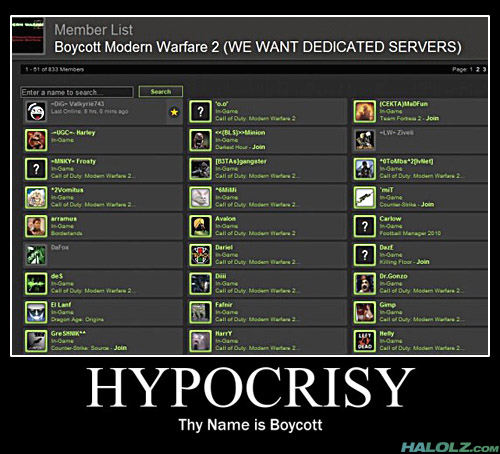
Overall I think it's just gamers are being, well, gamers. Like man groups, we have a bad tendency to whine and rant about every tiny supposed grievance, from DRM to Downloadable Content to a developer leaving out some tiny feature from a prequel. We also have a history of not standing up to our complaints at all. Case in point, the huge number of MW2 boycotters who purchased the game anyway (I know it's just a screenshot but there's actual numbers to back it up). I'm all for reducing trolling, racism, and all that negative stuff I hate dealing with whenever I'm on Xbox Live. I have nothing to hide, my behavior is, at least compared to many, exemplary: I have no problem with sticking my name next to my username if it's a good enough game. A large part of what is wrong with the internet can be attributed to anonymity, and while I'm all for personal freedom in certain senses, I think Blizzard in this case should have just stuck to its stance.
As always, I welcome your comments and counterpoints. And check back tomorrow for (probably) a post on the first Dark Heresy session, which starts tonight.
-HTMC
I'm writing this because I'm very much of the opposite view. I understand the uses of anonymity-- I don't like signing in to a lot of things just because of spammers, possible ID theft, and the whole slew of similar potential problems. In this case, however, I really think the whole audience is being, frankly, a bunch of idiots.
The only thing the ID thing would be doing is attaching your real name. While that's a fair bit of information, it's far from putting up sensitive information, and in my experience a lot of people give out their real names on forums, anyway. A name itself isn't going to give away much (especially if you have a rather common name) and if you really don't like it that much, you can just limit your forum use. I like the idea of not having to remember who actually owns a certain account (a problem I've had before) and I'm all for reducing trolling (which has been proven to be reduced when people are attached to a real identity, if I remember correctly).
One of the most ridiculous things is people telling Blizzard they have "lost their trust" and "need to earn it back." As far as I understand it, Blizzard never actually implemented this system, and aren't going to now due to feedback. It's one thing to get angry with a company for doing something "bad," it's another to have a fit about an idea that gets pulled back. I mean seriously guys, are you 6 years old? They threw out an idea, you threw a fit, they recognized the complaint and stopped it. You should be happy they even listened.
I think, quite honestly, that Blizzard should have just gone through with it if they thought it was a good idea. The internet in general seems to be moving more towards a "one ID/username" style system in a general sense, especially thanks to Facebook Connect.
Facebook is actually, I think, an excellent counterexample. The article I linked above mentioned how much users hate change. Facebook has changed its layout a number of times in the past 5 years, and every time a huge number of people threw a fit (myself included a couple times) but Facebook ignored it, and people settled down and kept moving on. Even with the recent privacy scandal, with an uproar equal if not greater than the Blizzard thing, I remember reading that an astonishingly low number of people actually quit the site. I'm pretty sure WoW is about as much of an establishment as Facebook; even with a controversial change to the Blizzard servers, I'm sure only a tiny minority would have actually quit.
In addition, the whole Facebook Connect thing seems, to me, to prove a good portion of the internet population don't prize anonymity that highly. Sure, you have 4Chan on one hand, but on the other I've noticed a lot of sites that now have comments with links directly to a real person's Facebook account. I would suspect that these comments tend to be higher quality and more polite than the average Youtube comment page, and although I personally wouldn't do it, I've been seeing it enough that I think I'm justified in calling it a trend. I could definitely envision a future where a large number of popular websites all allow some overarching single ID, and tied to a single real person somehow.
Overall I think it's just gamers are being, well, gamers. Like man groups, we have a bad tendency to whine and rant about every tiny supposed grievance, from DRM to Downloadable Content to a developer leaving out some tiny feature from a prequel. We also have a history of not standing up to our complaints at all. Case in point, the huge number of MW2 boycotters who purchased the game anyway (I know it's just a screenshot but there's actual numbers to back it up). I'm all for reducing trolling, racism, and all that negative stuff I hate dealing with whenever I'm on Xbox Live. I have nothing to hide, my behavior is, at least compared to many, exemplary: I have no problem with sticking my name next to my username if it's a good enough game. A large part of what is wrong with the internet can be attributed to anonymity, and while I'm all for personal freedom in certain senses, I think Blizzard in this case should have just stuck to its stance.
As always, I welcome your comments and counterpoints. And check back tomorrow for (probably) a post on the first Dark Heresy session, which starts tonight.
-HTMC
Subscribe to:
Posts (Atom)