Due to my 6-month sojourn, I only a couple weeks ago got around to playing Assassin's Creed 2. I only today beat it, since I went the semi-completionist route, and thought I'd share my thoughts, for those handful of you who haven't played the game yet still might (I'm guessing that's a very very small number, though).
As a sort of disclaimer, I really liked Assassin's Creed 1. The main complaint that most people had was the repetitiveness of the tasks, and while I was bothered a bit by this, overall I thought it was a great game, albeit with its fair share of flaws. Well, its sequel is pretty much the same: another great game, with a lot of cool new additions as befits a proper sequel, but again with its own flaws.
The biggest improvement is the number of things our noble (literally) Assassin can do, from a large number of weapons (pistols, poison, smoke bombs, lots of swords and daggers, etc) as well as some new techniques (picking up weapons, jumping while climbing, others). They also remedied some obvious flaws from 1, since the PC can now fall into water and not instantly die, although strangely enough the enemy still die instantly when making contact with any liquid. The missions are more varied and the "find x object" quests are either streamlined or eliminated (with the exception of the feathers). It still has great free running, and the locations and characters look as good as ever, with some decent voice work (although Ezio's fake-Italian accent bugged me the entire way through). Notoriety was a cool new touch, although I don't feel like it added much to the game mechanics. Basically they took everything that worked from the first game, kept it or improved it, then launched it into a new location with more cities.
However, on the negative side of things are some stuff they didn't improve. Combat-wise, counter-kills are still by far the most effective way to take down enemies, making combat somewhat monotonous, especially since I got my fill of counter-kill animations in the first game. I was even saddened by how few of them there were, and got bored pretty quickly (and the one time you can play as Desmond in combat, he has different kill animations, making me wonder why they didn't add more to Ezio). I only found out after I finished the game that you could learn additional attacks, something that game never told me was the case, which is rather annoying although after trying out I doubt I would have added many to my repertoire (except for the 3 dagger throw).
The enemy AI also varies between being incredibly dumb and preternaturally alert, which can get frustrating or laughably bad. For instance, walking up and stabbing three guards in a row while they all watch each other die, or having one go on alert, pull out his sword, and still allow me to walk up and hit him. On the other hand, an NPC walking into me, causing him to drop his box, one time instantly got guards on high alert. I did appreciate having the ability to buy NPCs like courtesans, but it felt kind of boring after the first few times and I never found a use for anything other than the whores. Go figure?
Also a holdover from 1 was the camera and control issues. Normally it's not a problem, but occasionally the camera would get kind of funky and more often than I was pleased with free running would do something stupid, like go diving off the side of the building. I suspect it's one of those selective memory things, where it works most of the time without me noticing it, but there'd be crucial times where I'm be attempting to beat a clock or something similar and an easy jump onto a wire would instead result in me nosediving onto the concrete.
Perhaps this is me having too high of expectations, but for being an assassin, the game is incredibly unstealthy. I want to do things kind of like Splinter Cell, but Ezio simply doesn't have a lot of the options, and often I feel like the maps aren't even designed to allow for stealthy type things. Even when I tried, it often just ended up being simple to kill everything, since even when there was a mob of 30 guards they'd all run away in fear once I killed 4 or 5 of them. The poison option was a nice touch, but beyond that there weren't a whole lot of stealthy options beyond going up and stabbing someone, and even the throwing knives are no longer 1 hit kills when thrown on unsuspecting guards.
The cities also disappointed me, but not from a gameplay perspective. One advantage to waiting to play the game was that 3 of the locations were cities I actually visited in the last 6 months, namely Florence, Venice, and Rome/Vatican. Florence felt a bit similar, but Venice was disappointing in that it's composed entirely of tiny streets. That means that, for balance/design reasons, the streets couldn't be realistic and had to be widened a lot. This meant Venice didn't really feel like Venice, which was a disappointment. I was also looking forward to Rome the entire time, only to be disappointed again when the final section in Rome was actually only about 10 minute on a wall of Vatican City. Even in the Sistine Chapel for some bizarre reason they decided to not include the ceiling, one of the most famous pieces of art in the world (Edit: Nevermind, they were being true to history. The ceiling hadn't been painted at the time the game takes place). Highly disappointing, although like I said the cities were still interesting, if not particularly true to life.
Finally, the story kind of bugged me. The first game was good, it set up a cool story and left me wanting more with a good twist at the end. The second tried for the same, but ended up making everything like a fanatic's conspiracy theory (every single major person in history is either a Templer or an Assassin, and every great man/women who died was assassinated, basically) to the point it just felt ridiculous. And this game's ending went so far over the top and out of the blue that I didn't feel "what a twiiiist" but rather "you're joking, right? o_0."
Assassin's Creed 2 is a solid game, and contains quite a lot of fun if you're the type who enjoys the genre, but be prepared for numerous small flaws that may or may not bug you depending on your personality. It definitely surpasses its predecessors in a number of ways, but also brings itself down in a few as well. It brought me a lot of hours of fun playing, and I'd recommend it for anyone who even half enjoyed the first game.
-HTMC
Saturday, July 31, 2010

Wednesday, July 28, 2010
Sinister Sacrilege: The Second Session
Last week was the second session of Dark Heresy, although in terms of my overall campaign planning it was more like session 1.5. However, we did finish the session plot arch and apparently everyone enjoyed themselves. For another excellent summary see that other guy's blog. But again from my perspective as GM, some other things came up during the session that I felt like I should comment on, so I shall.
The first has to do with players. Although I already know they can be surprisingly inventive (especially the group I play with) I got lulled back into a false sense of security the first session, since everything pretty much went Blaykakudori (Blaykaku means Blake's Plan). This session was full of surprises, though, from having Jesse's character start a rock concert to attract the attention of some heretical guards, Aaron attempting to go Inception-like on an unconscious Navigator, and Max made a smart but not expected by me move of accessing security records for the ship. All of these were very good ideas and most of them ended up gaining the PCs some advantage, but also meant I was constantly adjusting, which was interesting. The Inquisitor campaign I did was much more railroaded, almost like an on-rails shooter, whereas this session was designed to be "you're on a ship, go whereever you want." Thus the more interesting ideas.
Probably the most unexpected one had do with Inquisitor Schuld (alternatively called many other things by PCs, who have an annoying habit of never remembering any NPCs name). My plan for him was to be a nice friendly trainer Inquisitor just for the ship-board portion of the campaign, and then once the Broodlord and Genestealers rushed onto the scene, he would valiantly take on the Broodlord and they would mutually murder each other. What I didn't expect was for my PCs to ignore the Genestealers (and be finished with the Servitors and Guardsmen) and focus their entire fire for a turn on the Broodlord. I obviously couldn't just let them do that without any effect, so the Broodlord ended up seriously mauled while Inquisitor Schuld (or Badassius if you're Max) waltzed in and finished him off. So in effect, my PCs saved an NPC I had earmarked for death. I suspect this will have significant ramifications later. I guess the moral of the story for me is be prepared for anything.
Another factor that I'm forced to be conscious of is game balance, not in the sense of difficulty but in activities. I have 5 PCs, all with different talents and foci, and it would be bad form to focus on one are too much. For instance, a couple of the PCs are definitely combat-focused, whereas one is pretty much all out of combat mischief. Overall they're lacking in people-skills (as they found out when their friendly cleric went AWOL and the person with the best people-skills was, of all things, a Tech-priest) and are stacked more so in the ranged department (again found out when their cleric disappeared and they all stuck to ranged fire). I think this last session struck a good balance, with about 2 hours of investigation and 1.5 of combat, and future sessions will hopefully be somewhat more tailored to skills they have and enemies will also be made with them in mind.
Finally, a third problem I encountered (that hopefully wasn't a problem) was again linked to PC initiative and creativity. Obviously I had a lot of background planning and stuff done, in terms of what has happened before the "session" starts and what is going on during it. Obviously this was meant to be discoverable by the PCs, although they can't do it naturally. The problem arises when they either fail their skill checks or they don't bite on the hooks you give them. For instance, had they investigated the cargo room before attacking it they likely would have learned about the weirdly broken boxes, but they didn't follow the hints I dropped and choose to go later purely on the attack, and thus not be able to investigate. Thus the Genestealer attack probably seemed a lot more out of the blue than I intended, although hopefully my after-action debriefing made it make a little bit more sense. Although I didn't hear any "wtf's?" from the players, when I brought them out I totally had a "seriously guys this has an explanation, trust me" mindset. And of course Rome choose to question things like shift schedules and guard rotations, something I had never considered at all. So moral of the story is again don't plan on PCs necessarily investigating where you want or asking the questions you'd think they'd ask.
But, as I said, it was another great session, and brought to light (as you can see) a number of issues that'll hopefully make future ones even better. Emperor knows where the merry band of "The Good Guys" will end up next (hint: it won't be pleasant).
-HTMC
The first has to do with players. Although I already know they can be surprisingly inventive (especially the group I play with) I got lulled back into a false sense of security the first session, since everything pretty much went Blaykakudori (Blaykaku means Blake's Plan). This session was full of surprises, though, from having Jesse's character start a rock concert to attract the attention of some heretical guards, Aaron attempting to go Inception-like on an unconscious Navigator, and Max made a smart but not expected by me move of accessing security records for the ship. All of these were very good ideas and most of them ended up gaining the PCs some advantage, but also meant I was constantly adjusting, which was interesting. The Inquisitor campaign I did was much more railroaded, almost like an on-rails shooter, whereas this session was designed to be "you're on a ship, go whereever you want." Thus the more interesting ideas.
Probably the most unexpected one had do with Inquisitor Schuld (alternatively called many other things by PCs, who have an annoying habit of never remembering any NPCs name). My plan for him was to be a nice friendly trainer Inquisitor just for the ship-board portion of the campaign, and then once the Broodlord and Genestealers rushed onto the scene, he would valiantly take on the Broodlord and they would mutually murder each other. What I didn't expect was for my PCs to ignore the Genestealers (and be finished with the Servitors and Guardsmen) and focus their entire fire for a turn on the Broodlord. I obviously couldn't just let them do that without any effect, so the Broodlord ended up seriously mauled while Inquisitor Schuld (or Badassius if you're Max) waltzed in and finished him off. So in effect, my PCs saved an NPC I had earmarked for death. I suspect this will have significant ramifications later. I guess the moral of the story for me is be prepared for anything.
Another factor that I'm forced to be conscious of is game balance, not in the sense of difficulty but in activities. I have 5 PCs, all with different talents and foci, and it would be bad form to focus on one are too much. For instance, a couple of the PCs are definitely combat-focused, whereas one is pretty much all out of combat mischief. Overall they're lacking in people-skills (as they found out when their friendly cleric went AWOL and the person with the best people-skills was, of all things, a Tech-priest) and are stacked more so in the ranged department (again found out when their cleric disappeared and they all stuck to ranged fire). I think this last session struck a good balance, with about 2 hours of investigation and 1.5 of combat, and future sessions will hopefully be somewhat more tailored to skills they have and enemies will also be made with them in mind.
Finally, a third problem I encountered (that hopefully wasn't a problem) was again linked to PC initiative and creativity. Obviously I had a lot of background planning and stuff done, in terms of what has happened before the "session" starts and what is going on during it. Obviously this was meant to be discoverable by the PCs, although they can't do it naturally. The problem arises when they either fail their skill checks or they don't bite on the hooks you give them. For instance, had they investigated the cargo room before attacking it they likely would have learned about the weirdly broken boxes, but they didn't follow the hints I dropped and choose to go later purely on the attack, and thus not be able to investigate. Thus the Genestealer attack probably seemed a lot more out of the blue than I intended, although hopefully my after-action debriefing made it make a little bit more sense. Although I didn't hear any "wtf's?" from the players, when I brought them out I totally had a "seriously guys this has an explanation, trust me" mindset. And of course Rome choose to question things like shift schedules and guard rotations, something I had never considered at all. So moral of the story is again don't plan on PCs necessarily investigating where you want or asking the questions you'd think they'd ask.
But, as I said, it was another great session, and brought to light (as you can see) a number of issues that'll hopefully make future ones even better. Emperor knows where the merry band of "The Good Guys" will end up next (hint: it won't be pleasant).
-HTMC
Tuesday, July 27, 2010
All's Well That Ends Well: A Review of Damnatus
Some of you may be familiar with Damnatus, an extremely low-budget German fan-made 40k film that due to weird copyright differences between German and British law meant that it was never officially released. Naturally it was "leaked" to various torrent sites and the entirety of the film is even easily findable on Youtube, so I suspect it Games Workshops protests were more against the copyright loss than actually disliking the film, since they tend to pursue other copyright violations with extreme prejudice.
Nevertheless, I managed to acquire a copy and finally sat down to watch the 1 hour 45 minute production, and figured I should share my impressions with you.
First off, if you choose to watch it, made sure you approach it with the right mentality. If you go in expecting even an indie filmmaker type movie, you'll be disappointed, and probably end up laughing at a lot of it. If you go in thinking it was a movie made by a bunch of very enthusiastic and talented fans, you'll be very much impressed. The costumes and tone were well done, the story-line was decent if not mind-blowing, and the CGI for a lot of the scenes were far better than I expected. In particular however they did the servo-skulls was really cool, and I liked their Tech-priest costume a lot.
It does however have its weak points, particularly due to pacing. I feel like they wanted it to be a feature-length production, and thus there are quite a few shots that drag on a bit longer than they should, although never horribly so. The dialogue can be a bit stilted, and mostly not that impressive writing-wise (also, everything's in German with English subtitles, which wasn't a problem for me). The fight scenes were also a bit underwhelming, but again that's more due to the nature of the film than the actual shooting itself.
I think by far my favorite part though, has to do with the ending. Also, spoiler warning! If you don't want spoilers, stop reading this entry now. Anyway, the film follows a small kill-team who is sent to purge a cult, and they manage to do so although end up unleashing a Daemon. Now, it turns out my copy was a bit corrupted towards the end, so for the last 15 minutes I was somehow zoning out due to the occasional pausing and loss of visuals, but I perked back up at the end. For the entire team dies to a daemon. That's right, in the last 10 minutes a Daemon appears and kills everyone. I was all for this, since it was very 40k, but it seemed like an odd ending, and I was somewhat confused.
But not to worry! An Inquisitor, who we saw in the first minute of the movie and didn't appear again, finally arrives in his ship, and does the only logical thing to do when a single, lone Daemon appears on a planet:
Exterminatus!
So yes, we get treated to a nice sequence of the entire planet being bombed just because one minor daemon escaped onto the planet again. It's great, you'll love it, and it left me feeling very pleased, since it ended on a super grimdark note.
If you're really into 40k or just want to waste 2 hours on a halfway decent movie, I can recommend Damnatus: The Enemy Within. I bet it would be especially good in a group setting, especially one where people tend to talk a lot anyway.
-HTMC
Nevertheless, I managed to acquire a copy and finally sat down to watch the 1 hour 45 minute production, and figured I should share my impressions with you.
First off, if you choose to watch it, made sure you approach it with the right mentality. If you go in expecting even an indie filmmaker type movie, you'll be disappointed, and probably end up laughing at a lot of it. If you go in thinking it was a movie made by a bunch of very enthusiastic and talented fans, you'll be very much impressed. The costumes and tone were well done, the story-line was decent if not mind-blowing, and the CGI for a lot of the scenes were far better than I expected. In particular however they did the servo-skulls was really cool, and I liked their Tech-priest costume a lot.
It does however have its weak points, particularly due to pacing. I feel like they wanted it to be a feature-length production, and thus there are quite a few shots that drag on a bit longer than they should, although never horribly so. The dialogue can be a bit stilted, and mostly not that impressive writing-wise (also, everything's in German with English subtitles, which wasn't a problem for me). The fight scenes were also a bit underwhelming, but again that's more due to the nature of the film than the actual shooting itself.
I think by far my favorite part though, has to do with the ending. Also, spoiler warning! If you don't want spoilers, stop reading this entry now. Anyway, the film follows a small kill-team who is sent to purge a cult, and they manage to do so although end up unleashing a Daemon. Now, it turns out my copy was a bit corrupted towards the end, so for the last 15 minutes I was somehow zoning out due to the occasional pausing and loss of visuals, but I perked back up at the end. For the entire team dies to a daemon. That's right, in the last 10 minutes a Daemon appears and kills everyone. I was all for this, since it was very 40k, but it seemed like an odd ending, and I was somewhat confused.
But not to worry! An Inquisitor, who we saw in the first minute of the movie and didn't appear again, finally arrives in his ship, and does the only logical thing to do when a single, lone Daemon appears on a planet:
Exterminatus!
So yes, we get treated to a nice sequence of the entire planet being bombed just because one minor daemon escaped onto the planet again. It's great, you'll love it, and it left me feeling very pleased, since it ended on a super grimdark note.
If you're really into 40k or just want to waste 2 hours on a halfway decent movie, I can recommend Damnatus: The Enemy Within. I bet it would be especially good in a group setting, especially one where people tend to talk a lot anyway.
-HTMC
Monday, July 26, 2010
H^3: My first experience with a hats tournament
This past weekend I attended Hats Hops & Hucks 19, my first ever hats tournament for Ultimate. It was a hats tournament in the sense that all the teams were random (as if drawn out of a hat, although they were also supposed to be as balanced as possible) but also in the sense that it had one abnormal rule since it was a "fun" tournament: every player had to wear a hat at all times, otherwise anything you did while on the field was invalid, such as diving to catch a pass and then having your hat fall off.
Anyway, first the events themselves and then my overall impressions. I drove up Friday after dinner with Nathan and arrived at the campsites, where we set up out tent and talked to the few people we knew. There was a DJ on site and thus it wasn't quiet until around 11:30/12, so I sadly didn't get to go to sleep until then. We were awoken at 7:30 and drove to one of the field sites, where we got a pancake breakfast before playing out first game. I headed to my field and met my teammates for the weekend for the first time and about 10 minutes later got started on our first game. I played 4 in total that day, back-to-back for the last three since we went to hard cap each time. We did pretty well, winning 3 of our 4 games, and 2 other teams also had a 3-1 record forming a weird tie in which we had beat the team the other had lost to. It came down to point differentials, and in the end we were seeded 5th out of 15 teams for the next day. After a surprisingly good dinner I went and lied down for a while, suffering from a sun-induced headache, and eventually felt better and again didn't go to sleep until 1 due to the "party" going on, again with a DJ. 9:30 was the wake-up call for Sunday and we received another surprisingly good breakfast before playing our first single-elimination game against the team seeded 12th, which we won fairly easily after we got our synergy back. The next game was against the only team we had lost to, and we managed to beat them for the revenge match. I hadn't expected our team to get farther then this game, so happily surprised I found myself in the semifinals. The team we played next had a no-loss record, and so I suspect they were utterly stunned when we beat them 13-7, getting an early lead they were never able to overcome. Again to my surprise I found myself in the final game, something I had never done in a tournament before, facing again against a team that had never lost. We actually came out incredibly strong, getting a 6-0 lead before they finally started seriously fighting back. For this reason, although the other team was seeded better, they won the crowd (being heckled by a large crowd was also a new experience) and although they had a worrying comeback after halftime, we ended up winning 17-12. In an extra little cool thing, they had this thing called the "Magical Mythstery Score" (the theme for the weekend was Mythical creatures) where randomly during one of the games the person who caught that point would get free HHH for life. This point got announced during the finals game, and I ended up throwing the winning point. Sadly there was no award for the assist, but I did feel good about giving it to someone else.
Anyway, a hats tournament was definitely an interesting experience. On the positive side, it was definitely more about having fun then playing super competitively, and the majority of players had that mindset. Also, it was a good chance for me to get back to playing, since I just went 6 months without playing at all and I could definitely feel how out of practice I was. Thus 8 usually 2-hour games in 2 days was a definite boon to regaining my skills. In addition, the tournaments I usually go to are with "unequal" teams in that some teams are just naturally better than others, and in a hats tournament ideally every team has a good chance of beating another. While obviously this didn't happen, all the games we played were close, with several going to soft/hard cap. It was also kind of cool to play on a mixed team again, compared to the mens-only team at Claremont, and as a bonus all of our girls were really good. Unfortunately one of my friends got on a team that was rather sexist, and we played a couple teams where it felt like the girls were being somewhat ignored, but as a whole it was nice to see genders working together. Also, I paid a flat fee and got everything for the weekend (food, lodging, drinks, jersey, disc, etc) so it was nice to have a weekend where I just played Ultimate and didn't have to worry about anything else.
On the more negative side, the randomness thing can be bad too. I'm always more on the competetive, and if I ended up on a "bad" team I probably would have ended up rather frustrated. Also, I'm used to playing with players I know pretty well, so adjusting to new people is obviously a bit different. Plus, I'm not the best at names, so I didn't really get everyone's name down till the final game. One of the biggest problems I faced was also that, as I said, I was both a bit out of shape and out of practice at the start, which probably showed in my playing. Thus I wasn't playing even close to how I expect myself to play till the final game, which while is a good time to finally start also means I felt like I playing inferiorly up to that point. There were also lots of moments where I think it showed how much more professionally/competitively I've played in the past, since we'd say lots of tactical stuff on the sidelines, and I'd often be one of the only ones actually doing these things on the field, despite how often I'd help remind the others. For instance, the sidelines kept getting very clogged, and so I'd stay in the stack to keep that space free. I'd feel like I was looking lazy to others, but it wasn't as if I could cut with that many people in the space. Nathan had similar problems, and he confirmed that it wasn't just my imagination with these things. And even when I did have some good cuts, sometimes I'd get looked off for no good reason. While I expect this every once in a while, it happened a lot more than it has in the past. Still, I can't complain since we did win overall. I attribute this (and again Nathan agrees) to having a very balanced team: everyone was at least decently athletic, everyone could at least throw decent throws, everyone kind of knew what they were doing, and our girls were all great and often better than the opposing teams (something we exploited often). Thus, while we didn't have any signature strong points, we did everything well and by our 3rd game had a good rhythm and strategy that we just stuck with for the rest of the weekend. My only worry now is if I ever go back to a hats tournament it's unluckily I'll end up on another team like that.
I'm quite happy I went to the tournament, all complaints aside, since I feel much more in shape now as well as having had a fun weekend playing a sport I love. My biggest regret? My team was the Valkyries, we had a boombox, and I didn't think until Saturday to load my iPod with Ride of the Valkyries.
-HTMC
Anyway, first the events themselves and then my overall impressions. I drove up Friday after dinner with Nathan and arrived at the campsites, where we set up out tent and talked to the few people we knew. There was a DJ on site and thus it wasn't quiet until around 11:30/12, so I sadly didn't get to go to sleep until then. We were awoken at 7:30 and drove to one of the field sites, where we got a pancake breakfast before playing out first game. I headed to my field and met my teammates for the weekend for the first time and about 10 minutes later got started on our first game. I played 4 in total that day, back-to-back for the last three since we went to hard cap each time. We did pretty well, winning 3 of our 4 games, and 2 other teams also had a 3-1 record forming a weird tie in which we had beat the team the other had lost to. It came down to point differentials, and in the end we were seeded 5th out of 15 teams for the next day. After a surprisingly good dinner I went and lied down for a while, suffering from a sun-induced headache, and eventually felt better and again didn't go to sleep until 1 due to the "party" going on, again with a DJ. 9:30 was the wake-up call for Sunday and we received another surprisingly good breakfast before playing our first single-elimination game against the team seeded 12th, which we won fairly easily after we got our synergy back. The next game was against the only team we had lost to, and we managed to beat them for the revenge match. I hadn't expected our team to get farther then this game, so happily surprised I found myself in the semifinals. The team we played next had a no-loss record, and so I suspect they were utterly stunned when we beat them 13-7, getting an early lead they were never able to overcome. Again to my surprise I found myself in the final game, something I had never done in a tournament before, facing again against a team that had never lost. We actually came out incredibly strong, getting a 6-0 lead before they finally started seriously fighting back. For this reason, although the other team was seeded better, they won the crowd (being heckled by a large crowd was also a new experience) and although they had a worrying comeback after halftime, we ended up winning 17-12. In an extra little cool thing, they had this thing called the "Magical Mythstery Score" (the theme for the weekend was Mythical creatures) where randomly during one of the games the person who caught that point would get free HHH for life. This point got announced during the finals game, and I ended up throwing the winning point. Sadly there was no award for the assist, but I did feel good about giving it to someone else.
Anyway, a hats tournament was definitely an interesting experience. On the positive side, it was definitely more about having fun then playing super competitively, and the majority of players had that mindset. Also, it was a good chance for me to get back to playing, since I just went 6 months without playing at all and I could definitely feel how out of practice I was. Thus 8 usually 2-hour games in 2 days was a definite boon to regaining my skills. In addition, the tournaments I usually go to are with "unequal" teams in that some teams are just naturally better than others, and in a hats tournament ideally every team has a good chance of beating another. While obviously this didn't happen, all the games we played were close, with several going to soft/hard cap. It was also kind of cool to play on a mixed team again, compared to the mens-only team at Claremont, and as a bonus all of our girls were really good. Unfortunately one of my friends got on a team that was rather sexist, and we played a couple teams where it felt like the girls were being somewhat ignored, but as a whole it was nice to see genders working together. Also, I paid a flat fee and got everything for the weekend (food, lodging, drinks, jersey, disc, etc) so it was nice to have a weekend where I just played Ultimate and didn't have to worry about anything else.
On the more negative side, the randomness thing can be bad too. I'm always more on the competetive, and if I ended up on a "bad" team I probably would have ended up rather frustrated. Also, I'm used to playing with players I know pretty well, so adjusting to new people is obviously a bit different. Plus, I'm not the best at names, so I didn't really get everyone's name down till the final game. One of the biggest problems I faced was also that, as I said, I was both a bit out of shape and out of practice at the start, which probably showed in my playing. Thus I wasn't playing even close to how I expect myself to play till the final game, which while is a good time to finally start also means I felt like I playing inferiorly up to that point. There were also lots of moments where I think it showed how much more professionally/competitively I've played in the past, since we'd say lots of tactical stuff on the sidelines, and I'd often be one of the only ones actually doing these things on the field, despite how often I'd help remind the others. For instance, the sidelines kept getting very clogged, and so I'd stay in the stack to keep that space free. I'd feel like I was looking lazy to others, but it wasn't as if I could cut with that many people in the space. Nathan had similar problems, and he confirmed that it wasn't just my imagination with these things. And even when I did have some good cuts, sometimes I'd get looked off for no good reason. While I expect this every once in a while, it happened a lot more than it has in the past. Still, I can't complain since we did win overall. I attribute this (and again Nathan agrees) to having a very balanced team: everyone was at least decently athletic, everyone could at least throw decent throws, everyone kind of knew what they were doing, and our girls were all great and often better than the opposing teams (something we exploited often). Thus, while we didn't have any signature strong points, we did everything well and by our 3rd game had a good rhythm and strategy that we just stuck with for the rest of the weekend. My only worry now is if I ever go back to a hats tournament it's unluckily I'll end up on another team like that.
I'm quite happy I went to the tournament, all complaints aside, since I feel much more in shape now as well as having had a fun weekend playing a sport I love. My biggest regret? My team was the Valkyries, we had a boombox, and I didn't think until Saturday to load my iPod with Ride of the Valkyries.
-HTMC
Thursday, July 22, 2010
More like a Ripple: On Google Wave
So yesterday for some random reason I thought of Google Wave. What's that, you ask?
I'm guessing some of you had similar experiences with the product, and I logged into today for the first time in probably more than half a year (if not a lot more) just because I was thinking of writing this blog post. However, rather than analyze the product itself, I'd rather post my thoughts on why, unlike many other Google products, Wave seems to have made itself defunct almost at the start (much like the PSP Go)
To put it short, I think Google itself made Wave unnecessary by making its other programs as good if not better.
To preface this point a little, I have to confess that I never actually used Wave. Not a single Wave sent or received, but I think that's indicative of the problem: I never thought of a situation where I went "oh hey, I should try out Wave finally." I was part of the whole invites getting passed around, and could have given out more of my own, but everyone who was interested already had it, or many people simply didn't know what it was. But as stated, even with people I knew who had it, I never had a reason to use it.
The first big feature I remember being advertised is moving email more towards an IM service. The first problem with that is trying to eliminate IMs; I use a couple IM services, and I don't need to add another. The second and bigger problem is that Gmail already does act like a delayed IM service with it's awesome grouping feature. For instance, I have a 70-email long group regarding the Dark Heresy campaign. With any other email server that'd be a mess, but Gmail nicely groups them together, which is basically what Wave was offering. So number one reason why to use Wave made useless.
The second feature was sort of the overall purpose of Wave, that being group collaboration. But again, I feel that the Google Docs suite trumps this. For instance, the most common group project I do relies on Powerpoints, often with face-to-face meetings (being in college and all). Even when not together, as stated before Gmail works perfectly well to exchange ideas. But with something like a Powerpoint, the Google Docs version works wonders. I've used it a handful of times prepping presentations with a group, and the simultaneous edit and universal accessibility means no messing emailing of files and the like. It's a presentation that everyone in the group always sees the most current version of and can edit in real-time on their own computers. I'm not sure how you can get much more advanced on that front.
So yes, Wave seems to offer all these features but more cleanly, and with a more unified front, but the problem is getting people to use a different program just for that purpose when they already have things they like. People use Gmail for all their email needs oftentimes, not just group collaboration, and people oftentimes use the other Google Docs apps, even often for single projects. Wave is simply, while apparently a very nice program, too specialized. The easiest way I can see to make Wave relevent would be to incorporate Wave into Gmail, much like Google Docs are (amongst other programs). I honestly don't even understand why they didn't just do it in the first place. A good point here is Buzz: it created a ton of controversy, a lot of people didn't like it, but probably because it's built right into Gmail I have a couple friends who actually use it. And I'm sure overall Google has more people using Buzz than Wave, even though Wave had a much better "buzz" when it was announced and released (sorry, I couldn't resist).
As I said though, this is only my thoughts on the matter without any numbers. I'd like to hear your thoughts on the matter, and if you have any hard facts on the matter that'd be great too.
-HTMC
 |
| Comic borrowed from the Doghouse Diaries |
To put it short, I think Google itself made Wave unnecessary by making its other programs as good if not better.
To preface this point a little, I have to confess that I never actually used Wave. Not a single Wave sent or received, but I think that's indicative of the problem: I never thought of a situation where I went "oh hey, I should try out Wave finally." I was part of the whole invites getting passed around, and could have given out more of my own, but everyone who was interested already had it, or many people simply didn't know what it was. But as stated, even with people I knew who had it, I never had a reason to use it.
The first big feature I remember being advertised is moving email more towards an IM service. The first problem with that is trying to eliminate IMs; I use a couple IM services, and I don't need to add another. The second and bigger problem is that Gmail already does act like a delayed IM service with it's awesome grouping feature. For instance, I have a 70-email long group regarding the Dark Heresy campaign. With any other email server that'd be a mess, but Gmail nicely groups them together, which is basically what Wave was offering. So number one reason why to use Wave made useless.
The second feature was sort of the overall purpose of Wave, that being group collaboration. But again, I feel that the Google Docs suite trumps this. For instance, the most common group project I do relies on Powerpoints, often with face-to-face meetings (being in college and all). Even when not together, as stated before Gmail works perfectly well to exchange ideas. But with something like a Powerpoint, the Google Docs version works wonders. I've used it a handful of times prepping presentations with a group, and the simultaneous edit and universal accessibility means no messing emailing of files and the like. It's a presentation that everyone in the group always sees the most current version of and can edit in real-time on their own computers. I'm not sure how you can get much more advanced on that front.
So yes, Wave seems to offer all these features but more cleanly, and with a more unified front, but the problem is getting people to use a different program just for that purpose when they already have things they like. People use Gmail for all their email needs oftentimes, not just group collaboration, and people oftentimes use the other Google Docs apps, even often for single projects. Wave is simply, while apparently a very nice program, too specialized. The easiest way I can see to make Wave relevent would be to incorporate Wave into Gmail, much like Google Docs are (amongst other programs). I honestly don't even understand why they didn't just do it in the first place. A good point here is Buzz: it created a ton of controversy, a lot of people didn't like it, but probably because it's built right into Gmail I have a couple friends who actually use it. And I'm sure overall Google has more people using Buzz than Wave, even though Wave had a much better "buzz" when it was announced and released (sorry, I couldn't resist).
As I said though, this is only my thoughts on the matter without any numbers. I'd like to hear your thoughts on the matter, and if you have any hard facts on the matter that'd be great too.
-HTMC
Wednesday, July 21, 2010
Hollywood Complexity: A Review of Inception
It's funny, as has been discussed many other times in many other places, Hollywood has weird ideas about how certain things work. Electronics and technology are simultaneouslymore complex and more simple than they are in real life and guns might as well be in an alternate universe, among other things. Therefore I thought it was interesting that the first article I read about Inception (which unfortunately I don't have the link for) was talking about Inception's complexity.
Yes, although I apparently missed it while in Austria, apparently the "complexity" of Inception was a big marketing point, in that it was supposed to be unlike other Hollywood films and challenge you to think (I'm looking at you, every summer blockbuster ever). However, the article I read took the position that the American audience is actually smarter than Hollywood would like to believe, as evidenced by the number of "slow burn" complex movies that were only moderate successes at the box office but grew in popularity as time went on (I believe the Shawshank Redemption was one example). Article-man hoped Inception would do well, thus encouraging more complex movies, and hoped also that Inception actually would be complex.
Well, the first part seems to be true. And the second... maybe?
I liked Inception a lot. I enjoyed the film, it had good pacing and excellent cinematography. The actors all did their parts well, and taken aside from any expectations, I don't think I really had a single problem with the movie (aside from a car tumbling over a hill not counting as a "fall"). However, there was one point, and one point only, where I was at all confused by the movie. And that was during the first five minutes, and that was because I couldn't understand Ken Watanabe's Asian accent.
I read this post earlier today, and I agree, I can think of a handful of movies off the top of my head that confused me a lot more than this film did. Primer and Donnie Darko are my favorite two from the list, since the former I still don't understand and the latter I almost understood but it wasn't until I did some internet research that I got it all the way through, and once I did it was very satisifying. Both may be better films overall, since neither relies on fancy cinematics at all. Not that cinematics make a bad film, but I suspect that a movie like Avatar, though while enjoyable, doesn't have staying power, much like video game graphics are only important for a couple years till they're eventually outdated.
Of course, this is only my opinion, and if my Facebook feed is any indication, a lot of my friends loved it and though it was "mindblowing" or other similar adjectives. Am I in a minority who understood the film without any help at all? I mean, someone took the trouble to make this chart, but I feel like it's completely unnecessary, and want to ask "were you actually watching the movie and paying attention?" I even wish they hadn't done so much exposition in the beginning and made me work a bit more to understand what was going on. They set up something intriguing that I didn't quite understand, then spent a half hour explaining every last detail extremely clearly to Ellen Page.
In conclusion, I suppose it's good it was so popular. Perhaps more films like it will be created, and maybe some of them won't guide the viewer along every little step. And it's not that I don't Inception: as stated, I enjoyed the film a whole lot. But if that's what Hollywood thinks "complex" means, I'm more than a little disappointed.
-HTMC
Yes, although I apparently missed it while in Austria, apparently the "complexity" of Inception was a big marketing point, in that it was supposed to be unlike other Hollywood films and challenge you to think (I'm looking at you, every summer blockbuster ever). However, the article I read took the position that the American audience is actually smarter than Hollywood would like to believe, as evidenced by the number of "slow burn" complex movies that were only moderate successes at the box office but grew in popularity as time went on (I believe the Shawshank Redemption was one example). Article-man hoped Inception would do well, thus encouraging more complex movies, and hoped also that Inception actually would be complex.
Well, the first part seems to be true. And the second... maybe?
I liked Inception a lot. I enjoyed the film, it had good pacing and excellent cinematography. The actors all did their parts well, and taken aside from any expectations, I don't think I really had a single problem with the movie (aside from a car tumbling over a hill not counting as a "fall"). However, there was one point, and one point only, where I was at all confused by the movie. And that was during the first five minutes, and that was because I couldn't understand Ken Watanabe's Asian accent.
I read this post earlier today, and I agree, I can think of a handful of movies off the top of my head that confused me a lot more than this film did. Primer and Donnie Darko are my favorite two from the list, since the former I still don't understand and the latter I almost understood but it wasn't until I did some internet research that I got it all the way through, and once I did it was very satisifying. Both may be better films overall, since neither relies on fancy cinematics at all. Not that cinematics make a bad film, but I suspect that a movie like Avatar, though while enjoyable, doesn't have staying power, much like video game graphics are only important for a couple years till they're eventually outdated.
Of course, this is only my opinion, and if my Facebook feed is any indication, a lot of my friends loved it and though it was "mindblowing" or other similar adjectives. Am I in a minority who understood the film without any help at all? I mean, someone took the trouble to make this chart, but I feel like it's completely unnecessary, and want to ask "were you actually watching the movie and paying attention?" I even wish they hadn't done so much exposition in the beginning and made me work a bit more to understand what was going on. They set up something intriguing that I didn't quite understand, then spent a half hour explaining every last detail extremely clearly to Ellen Page.

In conclusion, I suppose it's good it was so popular. Perhaps more films like it will be created, and maybe some of them won't guide the viewer along every little step. And it's not that I don't Inception: as stated, I enjoyed the film a whole lot. But if that's what Hollywood thinks "complex" means, I'm more than a little disappointed.
-HTMC
Tuesday, July 20, 2010
Sinister Sacrilege: The First Session
This past Thursday I ran the first session of my Dark Heresy Campaign. A post from the player's perspective (and a considerably more entertaining one at that) can be found out at Mister Flask's blog, but I will add my own thoughts in from the GM's perspective (also skip down below for some additions to what Mr. Flask wrote).
For the record, Dark Heresy is a pen and paper RPG set in the Warhammer 40k universe, and this game features myself GMing and 5 PCs all playing over the internet.
First off, a problem I forsaw but didn't suspect would be quite so large: programs. When I ran Inquisitor (another 40k RPG, but not quite as good) last January, it was text-only and so we ran it exclusively through Vassal (with some Skype group IMing supplementing). We all had had Skype for quite some time, and the 3 PCs (Stormshrug, Flask, and Jesse) had all used Vassal before with me to play tabletop 40k. So set-up was relatively painless.
However, the addition of Voice for this campaign made things considerably more difficult. Although I had tried to make sure everyone was set up ahead of time, here's how things went down.
6:00- Kory and Rome are on. Rome realizes Voxli, the internet based group chat program I had planned to use, wasn't compatible with Linux, which I didn't know he was running
7:00- Rome manages to get Mumble/Murmur (think open-source Ventrilo/TeamSpeak) running on a personal server. We start trying to get everyone to install Mumble.
8:00- Problems installing Mumble continue. We realize not everyone has Vassal up and runnin
9:00- Stormshrug arrives, needs to download both programs. Takes some time.
9:30- Flask arrives, needs to download Mumble. Takes some time
10:00- Rome decides to restart computer since he's made so many changes. Problems occur and the Murmer server goes down with it
10:30- Finally, everything seems to be working, although Flask is having significant difficulties hearing and being heard. We start anyway
11:00- Jesse arrives, downloads Mumble, joins later
12:00- We end.
So despite having everyone try to be on by 8, we don't actually start until 2.5 hours later and only play for 1.5 hours, and probably less than that when you factor in interruptions. However, the PCs were very efficient in that short time frame. Here's my synopsis, since unfortunately Flask left out a couple minor details, probably due to the aforementioned voice difficulties.
PCs awaken on a ship yanked out of the Warp, and are tasked with investigating. They first head to the Bridge and look around, questioning a man who looks like he's in charge (he was actually the First Officer, but the PCs never bothered to ask, for whatever reason). From there they proceeded to the Power Generator Room, which led to the Engine room, only to be blocked to to lack of access privileges. After a lot of diplomacy they managed to secure the name of a commanding officer, and headed to a prison ward to meet with him, and eventually managed to secure the necessary authorization to enter the engine room. They also got hints about strange goings-on on the ship prior to Warp trouble, which presumably occurred during the long period they were in a virtual reality machine undergoing training.
Anyway! Notes on the session from my perspective.
One problem I didn't foresee was accents, strangely enough. Because I was actually having to voice my NPCs, I felt it necessary to differentiate my voice between characters. I tended to fall back on a British one automatically, for whatever reason, although I think a Germanic one entered at one point. I'm not sure how good/bad they sounded, but it's definitely something to both practice and write down for important NPCs.
Speaking of which, I don't know how much my fellow members have noticed, but I tend to fall back on straight German when in need of a non-standard name (which isn't surprising given my recent Austrian adventure). For instance, my Orpheus character had the last name Gotteson and he was a priest (misspelling intentional), two of my Inquisitors are called Glaub and Schuld, and an upcoming character has the surname von Droß, among other things. I actually don't know how many of them ran these names through translators (and I'm sure they will now), but they're usually appropriate in some way. I don't feel too bad about this though, since even Games Workshop has given us the Death Korps of Krieg and the Mordian regiment (War and Murder, respectively). Although sometimes I feel like I'm getting a bit too particular (not everyone in 40k can be Germanic) it's very useful to have another language to draw upon, especially one that fits well with the universe.
I also designed this session to be a bit more open-world. The PCs managed to find a map in the beginning, and had their choice as to where to investigate. I actually made a number of maps of common rooms in the ship, and the PCs were free to go whereever they wanted. I did have some concern over what kind of options they would take, and did a kind of quick practice run through with Emma (i.e. you're here and this happened, what would you do next?) and the PCs actually matched fairly well what she did, which is pretty much what I was expecting. What I was not expecting was the number of high rolls the PCs managed, including a few rolls I thought they were definitely going to miss since they had pretty high difficulty. They also tended to do a lot more social interaction and less straight up investigating, although I'm not sure if that's the situation in particular or the way I'm setting up the scene, so we'll see.
One problem that I'm lucky I planned ahead for was power and authority. In the 40k universe, the Inquisition has essentially unlimited power and ultimate authority. I guessed (and correctly at that) that the PCs would naturally abuse this as much as possible, which is especially easy while onboard an Imperial vessel where theoretically they have ultimate control. The solution was to make the PCs still in training while aboard the vessel, and thus not be official members of the Inquisition. They naturally still had an Inquisitor boss to fall back on when needed (and they did a couple times) but this handicap kept them from just charging through and doing anything they wanted without repercussions, which made for a much more interesting session, I think.
Overall though, everything seemed to be going pretty well. Once all the electronic problems were resolved, everyone was in character and making smart decisions, and putting asides Flask's communication problems (due to lousy internet) everyone seemed engaged and involved, which I think is in no small part due to the addition of voice. I have high hopes for the continuation of this session this Thursday, especially since combat is likely, and it should be a blast as soon as they make it off the ship (well, assuming they survive that long).
On a final note, the one biggest thing I picked up from Inquisitor (the last campaign) that seems really obvious but I didn't catch onto right away was that as a GM, I'm playing with the PCs, not against them. I think the problem was that as a video game player, I'm by and large used to competitive gameplay, where I'm trying to always "win," although the objective and means may change. Even as a PC in the other RPGs, I was still trying to "win" against whatever the GM threw at us. Thus I went into Inquisitor as almost "me against the PCs," which reared his ugly head when a PC came up with a clever way around a trap, and rather than let him do it I said no because it didn't fit with what I had planned. Obviously this led to a sour mood, and although I realized my error a bit later and "fixed" it, I still felt really bad for a while afterwards. Although there was some RPGs where it is indeed GM vs. PCs, Dark Heresy I feel isn't one of them. The PCs want to be challenged, want the potential to lose, but I don't think they want to feel that the GM is out to get them. Rather, I'm there to set a good scene and give the chance to overcome hard odds, and my enjoyment comes more from seeing the creative ways and approaches the PCs take. I made my PCs put a lot of effort into character creation, and I think it would be hard for both me and them if one of them died (not to say I won't do it if that's what happens, since it is 40k after all, but again that's not my goal per se). An RPG is a social event, and should be fun for everyone, if challenging a lot of the time. And if I want to get my way while still GMing, well, that's what NPCs are for.
Comments as always are welcome! Expect more updates weekly as the campaign progresses.
-HTMC
For the record, Dark Heresy is a pen and paper RPG set in the Warhammer 40k universe, and this game features myself GMing and 5 PCs all playing over the internet.
First off, a problem I forsaw but didn't suspect would be quite so large: programs. When I ran Inquisitor (another 40k RPG, but not quite as good) last January, it was text-only and so we ran it exclusively through Vassal (with some Skype group IMing supplementing). We all had had Skype for quite some time, and the 3 PCs (Stormshrug, Flask, and Jesse) had all used Vassal before with me to play tabletop 40k. So set-up was relatively painless.
However, the addition of Voice for this campaign made things considerably more difficult. Although I had tried to make sure everyone was set up ahead of time, here's how things went down.
6:00- Kory and Rome are on. Rome realizes Voxli, the internet based group chat program I had planned to use, wasn't compatible with Linux, which I didn't know he was running
7:00- Rome manages to get Mumble/Murmur (think open-source Ventrilo/TeamSpeak) running on a personal server. We start trying to get everyone to install Mumble.
8:00- Problems installing Mumble continue. We realize not everyone has Vassal up and runnin
9:00- Stormshrug arrives, needs to download both programs. Takes some time.
9:30- Flask arrives, needs to download Mumble. Takes some time
10:00- Rome decides to restart computer since he's made so many changes. Problems occur and the Murmer server goes down with it
10:30- Finally, everything seems to be working, although Flask is having significant difficulties hearing and being heard. We start anyway
11:00- Jesse arrives, downloads Mumble, joins later
12:00- We end.
So despite having everyone try to be on by 8, we don't actually start until 2.5 hours later and only play for 1.5 hours, and probably less than that when you factor in interruptions. However, the PCs were very efficient in that short time frame. Here's my synopsis, since unfortunately Flask left out a couple minor details, probably due to the aforementioned voice difficulties.
PCs awaken on a ship yanked out of the Warp, and are tasked with investigating. They first head to the Bridge and look around, questioning a man who looks like he's in charge (he was actually the First Officer, but the PCs never bothered to ask, for whatever reason). From there they proceeded to the Power Generator Room, which led to the Engine room, only to be blocked to to lack of access privileges. After a lot of diplomacy they managed to secure the name of a commanding officer, and headed to a prison ward to meet with him, and eventually managed to secure the necessary authorization to enter the engine room. They also got hints about strange goings-on on the ship prior to Warp trouble, which presumably occurred during the long period they were in a virtual reality machine undergoing training.
Anyway! Notes on the session from my perspective.
One problem I didn't foresee was accents, strangely enough. Because I was actually having to voice my NPCs, I felt it necessary to differentiate my voice between characters. I tended to fall back on a British one automatically, for whatever reason, although I think a Germanic one entered at one point. I'm not sure how good/bad they sounded, but it's definitely something to both practice and write down for important NPCs.
Speaking of which, I don't know how much my fellow members have noticed, but I tend to fall back on straight German when in need of a non-standard name (which isn't surprising given my recent Austrian adventure). For instance, my Orpheus character had the last name Gotteson and he was a priest (misspelling intentional), two of my Inquisitors are called Glaub and Schuld, and an upcoming character has the surname von Droß, among other things. I actually don't know how many of them ran these names through translators (and I'm sure they will now), but they're usually appropriate in some way. I don't feel too bad about this though, since even Games Workshop has given us the Death Korps of Krieg and the Mordian regiment (War and Murder, respectively). Although sometimes I feel like I'm getting a bit too particular (not everyone in 40k can be Germanic) it's very useful to have another language to draw upon, especially one that fits well with the universe.
I also designed this session to be a bit more open-world. The PCs managed to find a map in the beginning, and had their choice as to where to investigate. I actually made a number of maps of common rooms in the ship, and the PCs were free to go whereever they wanted. I did have some concern over what kind of options they would take, and did a kind of quick practice run through with Emma (i.e. you're here and this happened, what would you do next?) and the PCs actually matched fairly well what she did, which is pretty much what I was expecting. What I was not expecting was the number of high rolls the PCs managed, including a few rolls I thought they were definitely going to miss since they had pretty high difficulty. They also tended to do a lot more social interaction and less straight up investigating, although I'm not sure if that's the situation in particular or the way I'm setting up the scene, so we'll see.
One problem that I'm lucky I planned ahead for was power and authority. In the 40k universe, the Inquisition has essentially unlimited power and ultimate authority. I guessed (and correctly at that) that the PCs would naturally abuse this as much as possible, which is especially easy while onboard an Imperial vessel where theoretically they have ultimate control. The solution was to make the PCs still in training while aboard the vessel, and thus not be official members of the Inquisition. They naturally still had an Inquisitor boss to fall back on when needed (and they did a couple times) but this handicap kept them from just charging through and doing anything they wanted without repercussions, which made for a much more interesting session, I think.
Overall though, everything seemed to be going pretty well. Once all the electronic problems were resolved, everyone was in character and making smart decisions, and putting asides Flask's communication problems (due to lousy internet) everyone seemed engaged and involved, which I think is in no small part due to the addition of voice. I have high hopes for the continuation of this session this Thursday, especially since combat is likely, and it should be a blast as soon as they make it off the ship (well, assuming they survive that long).
On a final note, the one biggest thing I picked up from Inquisitor (the last campaign) that seems really obvious but I didn't catch onto right away was that as a GM, I'm playing with the PCs, not against them. I think the problem was that as a video game player, I'm by and large used to competitive gameplay, where I'm trying to always "win," although the objective and means may change. Even as a PC in the other RPGs, I was still trying to "win" against whatever the GM threw at us. Thus I went into Inquisitor as almost "me against the PCs," which reared his ugly head when a PC came up with a clever way around a trap, and rather than let him do it I said no because it didn't fit with what I had planned. Obviously this led to a sour mood, and although I realized my error a bit later and "fixed" it, I still felt really bad for a while afterwards. Although there was some RPGs where it is indeed GM vs. PCs, Dark Heresy I feel isn't one of them. The PCs want to be challenged, want the potential to lose, but I don't think they want to feel that the GM is out to get them. Rather, I'm there to set a good scene and give the chance to overcome hard odds, and my enjoyment comes more from seeing the creative ways and approaches the PCs take. I made my PCs put a lot of effort into character creation, and I think it would be hard for both me and them if one of them died (not to say I won't do it if that's what happens, since it is 40k after all, but again that's not my goal per se). An RPG is a social event, and should be fun for everyone, if challenging a lot of the time. And if I want to get my way while still GMing, well, that's what NPCs are for.
Comments as always are welcome! Expect more updates weekly as the campaign progresses.
-HTMC
Sunday, July 18, 2010
Live on OnLive: A Review
Ever since I found out about OnLive I've been somewhat interested, if a bit doubtful, so when I saw they were having an open beta I entered my name and left it at that. I didn't receive any info for a long time, but then a couple weeks ago I saw they were offering one year free for select applicants, so I applied, again unhopeful, but to my surprise two days later I got an invite.
For those of you not aware, OnLive is cloud computing applied to gaming. Thus computers somewhere off distant (this will be important later) have the games loaded and do all the processing, whereas you send commands via the internet and receive images in return. The idea is high quality PC gaming without the cost or the mess.
I installed the program and got it running, which took a surprisingly short amount of time. The game library at the moment is rather small, but does have a few notable titles such as Assassin's Creed 2 and Borderlands, and obviously their intention is to widen this pool as much as possible. A lot of the games had a demo option (for a max of 1/2 hour) so I did that with the two aforementioned games, and it is from that roughly hour of gaming that I draw my following conclusions.
Positives
Computer doesn't matter. I was playing on my Mac, which first of all meant I was able to play games I otherwise couldn't (although Steam is trying to change that). Secondly, even if I was playing on a netbook, if I had had a good enough connection it would have functioned as well as a thousands-of-dollars gaming set-up. In addition, the computer didn't speed up, heat up, etc, and was processing like it was working on a high-def YouTube video. Games loaded quickly and looked great, and sound was about what I was expecting from what I could tell. The spectating and "brag clip" integration could be potentially nice if I had other friends on the service, but since I don't I didn't explore it much.
Negatives
Lag. Lag lag lag lag lag. On the FPS (Borderlands) every time I adjusted the view it jarred, almost making me a bit motion sick towards the end, although running and aiming weren't too bad. I have a fairly fast connection that in the past has never been the problem, so I have a hard time imagining it being better, and could definitely see it being a lot worse. Assassin's Creed 2 wasn't as bad, but it still felt a bit disjointed, more noticeable because I've been playing it on my 360. Although the lag was not nearly as bad as I was expecting, it would definitely make me question buying it.
Also, while in the future I would have have to pay for the service, I was surprised by the price of the game. You can, for most games, do "Play Passes" for 3 or 5 days for varying prices, or you can buy the complete game for retail price. First of all, if it's a paid service I don't like paying full price for a game I'd lose if I quit the service. Additionally, if I'm paying a base price I'd appreciate seeing some free games, even if they're older and not quite current-gen.
Lastly, although this is a very unrealistic wish, it would be nice if I bought a PC game, it had an option to play it through OnLive as an extra bonus, just so if you wanted to play your game when low on battery or on a different computer and didn't want to go through an install process, or something like that. I doubt I'll ever see that happen, but it would be nice.
Conclusion
OnLive has a lot of potential, and I could see it growing into something I'd be interested in given a few years, but as it stands right now they need to address the lag and library issues before I'd consider giving them more money. I'll definitely keep an eye out for it as it advances, though.
-HTMC
Thursday, July 15, 2010
Anonymity and the Internet
So as some of you have heard, there has been some recent controversy with Blizzard and RealID. Basically Blizzard wanted to link accounts (all their games + official forums) under one master account, that being the user's real name. Naturally there was a huge uproar that's apparently just starting to settle down.
I'm writing this because I'm very much of the opposite view. I understand the uses of anonymity-- I don't like signing in to a lot of things just because of spammers, possible ID theft, and the whole slew of similar potential problems. In this case, however, I really think the whole audience is being, frankly, a bunch of idiots.
The only thing the ID thing would be doing is attaching your real name. While that's a fair bit of information, it's far from putting up sensitive information, and in my experience a lot of people give out their real names on forums, anyway. A name itself isn't going to give away much (especially if you have a rather common name) and if you really don't like it that much, you can just limit your forum use. I like the idea of not having to remember who actually owns a certain account (a problem I've had before) and I'm all for reducing trolling (which has been proven to be reduced when people are attached to a real identity, if I remember correctly).
One of the most ridiculous things is people telling Blizzard they have "lost their trust" and "need to earn it back." As far as I understand it, Blizzard never actually implemented this system, and aren't going to now due to feedback. It's one thing to get angry with a company for doing something "bad," it's another to have a fit about an idea that gets pulled back. I mean seriously guys, are you 6 years old? They threw out an idea, you threw a fit, they recognized the complaint and stopped it. You should be happy they even listened.
I think, quite honestly, that Blizzard should have just gone through with it if they thought it was a good idea. The internet in general seems to be moving more towards a "one ID/username" style system in a general sense, especially thanks to Facebook Connect.
Facebook is actually, I think, an excellent counterexample. The article I linked above mentioned how much users hate change. Facebook has changed its layout a number of times in the past 5 years, and every time a huge number of people threw a fit (myself included a couple times) but Facebook ignored it, and people settled down and kept moving on. Even with the recent privacy scandal, with an uproar equal if not greater than the Blizzard thing, I remember reading that an astonishingly low number of people actually quit the site. I'm pretty sure WoW is about as much of an establishment as Facebook; even with a controversial change to the Blizzard servers, I'm sure only a tiny minority would have actually quit.
In addition, the whole Facebook Connect thing seems, to me, to prove a good portion of the internet population don't prize anonymity that highly. Sure, you have 4Chan on one hand, but on the other I've noticed a lot of sites that now have comments with links directly to a real person's Facebook account. I would suspect that these comments tend to be higher quality and more polite than the average Youtube comment page, and although I personally wouldn't do it, I've been seeing it enough that I think I'm justified in calling it a trend. I could definitely envision a future where a large number of popular websites all allow some overarching single ID, and tied to a single real person somehow.
Overall I think it's just gamers are being, well, gamers. Like man groups, we have a bad tendency to whine and rant about every tiny supposed grievance, from DRM to Downloadable Content to a developer leaving out some tiny feature from a prequel. We also have a history of not standing up to our complaints at all. Case in point, the huge number of MW2 boycotters who purchased the game anyway (I know it's just a screenshot but there's actual numbers to back it up). I'm all for reducing trolling, racism, and all that negative stuff I hate dealing with whenever I'm on Xbox Live. I have nothing to hide, my behavior is, at least compared to many, exemplary: I have no problem with sticking my name next to my username if it's a good enough game. A large part of what is wrong with the internet can be attributed to anonymity, and while I'm all for personal freedom in certain senses, I think Blizzard in this case should have just stuck to its stance.
As always, I welcome your comments and counterpoints. And check back tomorrow for (probably) a post on the first Dark Heresy session, which starts tonight.
-HTMC
I'm writing this because I'm very much of the opposite view. I understand the uses of anonymity-- I don't like signing in to a lot of things just because of spammers, possible ID theft, and the whole slew of similar potential problems. In this case, however, I really think the whole audience is being, frankly, a bunch of idiots.
The only thing the ID thing would be doing is attaching your real name. While that's a fair bit of information, it's far from putting up sensitive information, and in my experience a lot of people give out their real names on forums, anyway. A name itself isn't going to give away much (especially if you have a rather common name) and if you really don't like it that much, you can just limit your forum use. I like the idea of not having to remember who actually owns a certain account (a problem I've had before) and I'm all for reducing trolling (which has been proven to be reduced when people are attached to a real identity, if I remember correctly).
One of the most ridiculous things is people telling Blizzard they have "lost their trust" and "need to earn it back." As far as I understand it, Blizzard never actually implemented this system, and aren't going to now due to feedback. It's one thing to get angry with a company for doing something "bad," it's another to have a fit about an idea that gets pulled back. I mean seriously guys, are you 6 years old? They threw out an idea, you threw a fit, they recognized the complaint and stopped it. You should be happy they even listened.
I think, quite honestly, that Blizzard should have just gone through with it if they thought it was a good idea. The internet in general seems to be moving more towards a "one ID/username" style system in a general sense, especially thanks to Facebook Connect.
Facebook is actually, I think, an excellent counterexample. The article I linked above mentioned how much users hate change. Facebook has changed its layout a number of times in the past 5 years, and every time a huge number of people threw a fit (myself included a couple times) but Facebook ignored it, and people settled down and kept moving on. Even with the recent privacy scandal, with an uproar equal if not greater than the Blizzard thing, I remember reading that an astonishingly low number of people actually quit the site. I'm pretty sure WoW is about as much of an establishment as Facebook; even with a controversial change to the Blizzard servers, I'm sure only a tiny minority would have actually quit.
In addition, the whole Facebook Connect thing seems, to me, to prove a good portion of the internet population don't prize anonymity that highly. Sure, you have 4Chan on one hand, but on the other I've noticed a lot of sites that now have comments with links directly to a real person's Facebook account. I would suspect that these comments tend to be higher quality and more polite than the average Youtube comment page, and although I personally wouldn't do it, I've been seeing it enough that I think I'm justified in calling it a trend. I could definitely envision a future where a large number of popular websites all allow some overarching single ID, and tied to a single real person somehow.
Overall I think it's just gamers are being, well, gamers. Like man groups, we have a bad tendency to whine and rant about every tiny supposed grievance, from DRM to Downloadable Content to a developer leaving out some tiny feature from a prequel. We also have a history of not standing up to our complaints at all. Case in point, the huge number of MW2 boycotters who purchased the game anyway (I know it's just a screenshot but there's actual numbers to back it up). I'm all for reducing trolling, racism, and all that negative stuff I hate dealing with whenever I'm on Xbox Live. I have nothing to hide, my behavior is, at least compared to many, exemplary: I have no problem with sticking my name next to my username if it's a good enough game. A large part of what is wrong with the internet can be attributed to anonymity, and while I'm all for personal freedom in certain senses, I think Blizzard in this case should have just stuck to its stance.
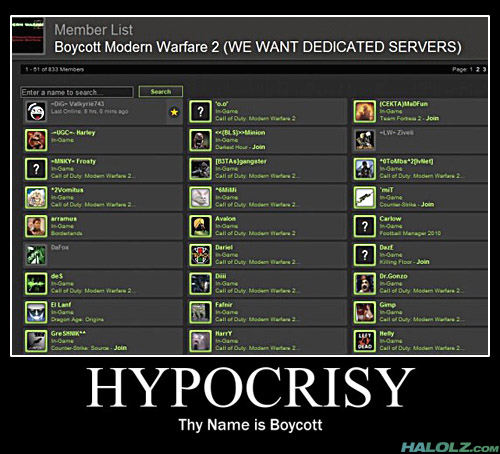
As always, I welcome your comments and counterpoints. And check back tomorrow for (probably) a post on the first Dark Heresy session, which starts tonight.
-HTMC
Wednesday, July 14, 2010
E3 2010
As a sort of starter, if anyone comes up with a good name for this blog that isn't "Iron Lord Byron" (thanks anyway Aaron) let me know.
Otherwise, I wanted to, a month late, sort of dissect E3 2010. When I did it for 2009, it seemed fairly popular, and I had actually intended and started to do something similar, only to discover the problem that I didn't have much to say.
For whatever reason, the games themselves didn't really inspire any strong feelings with me one way or the other. Sure, things like Gears of War 3 and other new sequels looked good, but nothing I felt compelled to write about. What I did think was more interesting was just the overall trends and what seem like goals for each of the Big Three. So instead, I present my short opinions and evaluations of the companies. As a sort of disclaimer, I do have all 3 consoles in my household, and if I show preference it's because of rational reasons, not rampant fanboyism.
Sony
Oh boy. Honestly, I think Sony is dropping the ball on pretty much every count, although partly this is just personal preference. I think a major factor is just the fact that Sony isn't just a game company; for instance, their move towards 3D gaming reeks simple of the fact that Sony is selling 3D TVs, and PS3 is naturally being forced to follow suit in order to sell more Sony TVs. Sony has in the past appealed more to the "hardcore" gamer crowd, and while I'm sure some people are willing to shell out more money for a TV and then the games to play it with, I doubt they're in the majority. Also, I can't imagine enjoying having to wear glasses everytime I play a game; the concept just sounds weird to me.
The whole Move thing seems almost too obvious to comment on, but seriously, it's a Wii knock-off. I think the large problem is the Wii sold so well because of the control scheme; people thought it was cool, and bought a Wii. The problem is that most people already have a Wii, so why bother buying Move? Its strong points are supposed to be better responses and higher graphics, but again, the Wii sold because of the controls, not the graphics (and I don't hear most people complaining about sensitivity) so again, I think the Move will only appeal to a small minority. Sony also seems to be trying to retarget the casual market and have forgotten that most people who bought a PS3 was for "hardcore" gaming, and the casual market is not going to be willing to spend hundreds of dollars for a new console, games, and the very pricy set of 4 controllers (and potentially a new TV) when you can get a Wii and a much larger library of games for much cheaper.
Purely on the games front, the PS3 has always had a very small selection of games I'm interested in. I played both MGS4 and Unchartered 2 I played both briefly and lost interest within minutes, whereas things like Resistance and Killzone feel uninspired to be. I did like the demo for Heavy Rain a lot, but as you can see that's a very low number of games that I've even considered buying.
Microsoft
Microsoft is in the middle. I don't think they're doing anything great, but they're not doing anything really bad. They're continuing to put out games that the install base wants: Gears, Halo, etc. They redesigned the console to apparently be better (I haven't heard one way or the other whether this is the case) and overall just seem to be chugging along.
The issue of Kinect/Natal is interesting. I like that at least it's something different, but the large lack of actual demos (instead of prerecorded videos) is worrying. Another big issue that I read at some other site and I have unfortunately forgot where is standardization. When you tell someone to press "A" on a controller, there's no ambiguity. However, tell someone to "drive" with Natal, and you have the case where some people drive at 11 and 1, some at 10 and 2, some with one hang at 12 and the other out the window. This is just one example, but essentially people don't always make the same motions as others, which I imagine makes programming recognition for games difficult. I feel like it's one of those things that I'll have to try personally before giving a final verdict.
Nintendo
To be perfectly upfront, I think Nintendo is, at the moment, the company showing the most intelligence. I think this is partially due to the fact that they are only a game company (compared to Sony with their TV motive). What essentially seems to have happened is Nintendo is starting to flatline on the new install base; most people who wanted a Wii have one, and there's a large library of games for casual gamers and still more coming out. With that base secure, they've shifted their attention back to their old crowd, the hardcore gamers, and are releasing a ton of games with them in mind, like Starfox 64, Goldeneye 007, new Metroid, new Donkey Kong, new Kirby, new Kid Icarus, etc. This means on the software front they should continue selling well, since even if one title fails there's lot of others.
The other big new is the 3DS. At first I was skeptical, but based on reviews from E3 apparently 3D without glasses does work, and sounds vastly preferable to the traditional 3D viewing. The other big factor is the number of companies that have announced games for the system already, something that staggered me. Metal Gear, Sims, Resident Evil, Kingdom Hearts, Ghost Recon & Splinter Cell and many more,alongside a large number of first party titles and Nintendo 64 updates means that either the developers like the system a lot or suspect it will be successful, which almost amounts to the same thing. Nintendo got it right with touch controls and motion controls, so while 3D doesn't add quite as much to the experience, I expect Nintendo to do it well.
Conclusion
Nintendo is addressing all its markets well, and strengthening its already solid base further. Microsoft is continuing what it's been doing for years now, and will likely succeed without real innovation. Sony is too wrapped up in corporate politics and is out of touch with their fan base.
But, like last year, I welcome your opinions, agreement or contradictions, especially if you think I left anything out. This Blog is ideally a place for discussion, not just a soapbox from which I can type. Until next time,
-HTMC
Otherwise, I wanted to, a month late, sort of dissect E3 2010. When I did it for 2009, it seemed fairly popular, and I had actually intended and started to do something similar, only to discover the problem that I didn't have much to say.
For whatever reason, the games themselves didn't really inspire any strong feelings with me one way or the other. Sure, things like Gears of War 3 and other new sequels looked good, but nothing I felt compelled to write about. What I did think was more interesting was just the overall trends and what seem like goals for each of the Big Three. So instead, I present my short opinions and evaluations of the companies. As a sort of disclaimer, I do have all 3 consoles in my household, and if I show preference it's because of rational reasons, not rampant fanboyism.
Sony
Oh boy. Honestly, I think Sony is dropping the ball on pretty much every count, although partly this is just personal preference. I think a major factor is just the fact that Sony isn't just a game company; for instance, their move towards 3D gaming reeks simple of the fact that Sony is selling 3D TVs, and PS3 is naturally being forced to follow suit in order to sell more Sony TVs. Sony has in the past appealed more to the "hardcore" gamer crowd, and while I'm sure some people are willing to shell out more money for a TV and then the games to play it with, I doubt they're in the majority. Also, I can't imagine enjoying having to wear glasses everytime I play a game; the concept just sounds weird to me.
The whole Move thing seems almost too obvious to comment on, but seriously, it's a Wii knock-off. I think the large problem is the Wii sold so well because of the control scheme; people thought it was cool, and bought a Wii. The problem is that most people already have a Wii, so why bother buying Move? Its strong points are supposed to be better responses and higher graphics, but again, the Wii sold because of the controls, not the graphics (and I don't hear most people complaining about sensitivity) so again, I think the Move will only appeal to a small minority. Sony also seems to be trying to retarget the casual market and have forgotten that most people who bought a PS3 was for "hardcore" gaming, and the casual market is not going to be willing to spend hundreds of dollars for a new console, games, and the very pricy set of 4 controllers (and potentially a new TV) when you can get a Wii and a much larger library of games for much cheaper.
Purely on the games front, the PS3 has always had a very small selection of games I'm interested in. I played both MGS4 and Unchartered 2 I played both briefly and lost interest within minutes, whereas things like Resistance and Killzone feel uninspired to be. I did like the demo for Heavy Rain a lot, but as you can see that's a very low number of games that I've even considered buying.
Microsoft
Microsoft is in the middle. I don't think they're doing anything great, but they're not doing anything really bad. They're continuing to put out games that the install base wants: Gears, Halo, etc. They redesigned the console to apparently be better (I haven't heard one way or the other whether this is the case) and overall just seem to be chugging along.
The issue of Kinect/Natal is interesting. I like that at least it's something different, but the large lack of actual demos (instead of prerecorded videos) is worrying. Another big issue that I read at some other site and I have unfortunately forgot where is standardization. When you tell someone to press "A" on a controller, there's no ambiguity. However, tell someone to "drive" with Natal, and you have the case where some people drive at 11 and 1, some at 10 and 2, some with one hang at 12 and the other out the window. This is just one example, but essentially people don't always make the same motions as others, which I imagine makes programming recognition for games difficult. I feel like it's one of those things that I'll have to try personally before giving a final verdict.
Nintendo
To be perfectly upfront, I think Nintendo is, at the moment, the company showing the most intelligence. I think this is partially due to the fact that they are only a game company (compared to Sony with their TV motive). What essentially seems to have happened is Nintendo is starting to flatline on the new install base; most people who wanted a Wii have one, and there's a large library of games for casual gamers and still more coming out. With that base secure, they've shifted their attention back to their old crowd, the hardcore gamers, and are releasing a ton of games with them in mind, like Starfox 64, Goldeneye 007, new Metroid, new Donkey Kong, new Kirby, new Kid Icarus, etc. This means on the software front they should continue selling well, since even if one title fails there's lot of others.
The other big new is the 3DS. At first I was skeptical, but based on reviews from E3 apparently 3D without glasses does work, and sounds vastly preferable to the traditional 3D viewing. The other big factor is the number of companies that have announced games for the system already, something that staggered me. Metal Gear, Sims, Resident Evil, Kingdom Hearts, Ghost Recon & Splinter Cell and many more,alongside a large number of first party titles and Nintendo 64 updates means that either the developers like the system a lot or suspect it will be successful, which almost amounts to the same thing. Nintendo got it right with touch controls and motion controls, so while 3D doesn't add quite as much to the experience, I expect Nintendo to do it well.
Conclusion
Nintendo is addressing all its markets well, and strengthening its already solid base further. Microsoft is continuing what it's been doing for years now, and will likely succeed without real innovation. Sony is too wrapped up in corporate politics and is out of touch with their fan base.
But, like last year, I welcome your opinions, agreement or contradictions, especially if you think I left anything out. This Blog is ideally a place for discussion, not just a soapbox from which I can type. Until next time,
-HTMC
Tuesday, July 13, 2010
Jumpin' on the bandwagon
So to avoid this blog standing at just an introduction, I shall follow up on a post made by my two cohorts-in-crimeGMing. The original posts can be found here and here.
To quickly actually write this down, here's my experience with tabletop RPGs (which have nothing to do with the far superior amount of hours spent with videogame RPGs)
1. Player in a Max/Aaron-co-DM'd, 13-session DnD campaign
2. GM'd a 4-session Inquisitor game
3. Player in a 6-sesssion Orpheus game GM'd by Rome
4. About to embark on an X-session Dark Heresy campaign, GM'd by me
Of those, all but one are/will be electronic only, and to further divide it 2 and 3 were text only while 4 will be text and voice.
With that said, I have overall more experience with face-to-face RPGs, but also a lot of electronic experience, and unlike Mr. Flask and Stormshrug (I think?) I have actually GM'd a session online, so I thought I'd contribute my two cents in that direction.
Advantages!
1. Maps. Especially for the 2 40k based systems that don't use a tile system, it has been way nicer and more convenient to create electronic maps, have electronic models, and do distance and movement without a lot of awkward use of rulers. Also quick switching to new maps is a lot easier.
2. Descriptions: As said elsewhere, the ability to copy-paste long descriptions and what I called "cutscenes" made it a lot easier to me to send out a lot at once, and because reading is more active than listening I could be relatively sure most of what I wrote was getting absorbed, at least somewhat.
3. Prioritizing: I know with the face-to-face, there would be moments where all 4 of us were trying to get Aaron/Max's attention, and obviously a person can only deal with so many inputs at once. I would end up trying to get the current DM's attention for a couple minutes, or have to wait patiently, or sometimes get my question forgot. This is no fault of anyone's, since a person can only pay attention to so much at once, but with text-only I can respond in order and look back at all the questions to see what I need to still address, which helps both the players and the GM.
4. Resources: When I GM'd Inquisitor, I had two monitors up, and on them I had the game board, a dice roller, Skype for the IMing, my planned notes, an electronic copy of the rules, notes for the current session, a browser up for quick searching, as well as a physical copy of the rules next to me. This made looking things up and dealing with problems super efficient, and it's simply not possible to have so much stuff up in face-to-face unless you steal an entire half of the table. And certainly not as efficient.
Disadvantages!
1. Side chatting: I've definitely done this as a player, so it's understandable, but as a face-to-face DM you're always partial to conversations players have, which means you can potentially shoot down bad/unreasonable ideas before too much thought is put into them. However, with online you can get players making plans in private chats, which means that they can potentially come up with elaborate plans that might have a fatal overlooked flaw (I don't think this has happened, but I could see it occurring). It can also cause players to get distracted from the main screen, since I know there were a few moments where I thought players weren't paying attention but were just talking to each other. Hopefully adding voice will prevent the latter.
2. Rules look-up: In face-to-face you can find a rule/power/etc and look at it together, whereas online you have to find it yourself, tell the player(s) the page, wait for them to find it themselves, and then discuss it. Not necessarily a lot of extra time, but it's still more slow-down in what is already a nuisance that pulls players out of the moment.
3. Friendly chatting: Although on one hand out-of-character conversation is bad, on the other you are gathered with your friends for a social event, so that kind of chatter can be very enjoyable. Being limited to a chatroom limits this a lot, and even though voice chatting should help a lot, considering how much communication is nonverbal I suspect it still won't be quite the same.
Conclusion(?)
Obviously while I do have the edge of GMing electronically, I don't have the experience of GMing face-to-face to compare it with, so I am at somewhat of a disadvantage for comparing the two. Although it's somewhat of a cop-out, it's probably safe to say that both methods have their benefits, and it might even be that certain systems benefit from one style more than the other. With that said, I'm really glad I have electronic means for breaks when physical meeting is impossible.
Well, that's the first real post. Now to hopefully remember all those other topics I thought it'd be interesting to write about and start on that. Also expect updates on Dark Heresy once we start.
-HTMC
To quickly actually write this down, here's my experience with tabletop RPGs (which have nothing to do with the far superior amount of hours spent with videogame RPGs)
1. Player in a Max/Aaron-co-DM'd, 13-session DnD campaign
2. GM'd a 4-session Inquisitor game
3. Player in a 6-sesssion Orpheus game GM'd by Rome
4. About to embark on an X-session Dark Heresy campaign, GM'd by me
Of those, all but one are/will be electronic only, and to further divide it 2 and 3 were text only while 4 will be text and voice.
With that said, I have overall more experience with face-to-face RPGs, but also a lot of electronic experience, and unlike Mr. Flask and Stormshrug (I think?) I have actually GM'd a session online, so I thought I'd contribute my two cents in that direction.
Advantages!
1. Maps. Especially for the 2 40k based systems that don't use a tile system, it has been way nicer and more convenient to create electronic maps, have electronic models, and do distance and movement without a lot of awkward use of rulers. Also quick switching to new maps is a lot easier.
2. Descriptions: As said elsewhere, the ability to copy-paste long descriptions and what I called "cutscenes" made it a lot easier to me to send out a lot at once, and because reading is more active than listening I could be relatively sure most of what I wrote was getting absorbed, at least somewhat.
3. Prioritizing: I know with the face-to-face, there would be moments where all 4 of us were trying to get Aaron/Max's attention, and obviously a person can only deal with so many inputs at once. I would end up trying to get the current DM's attention for a couple minutes, or have to wait patiently, or sometimes get my question forgot. This is no fault of anyone's, since a person can only pay attention to so much at once, but with text-only I can respond in order and look back at all the questions to see what I need to still address, which helps both the players and the GM.
4. Resources: When I GM'd Inquisitor, I had two monitors up, and on them I had the game board, a dice roller, Skype for the IMing, my planned notes, an electronic copy of the rules, notes for the current session, a browser up for quick searching, as well as a physical copy of the rules next to me. This made looking things up and dealing with problems super efficient, and it's simply not possible to have so much stuff up in face-to-face unless you steal an entire half of the table. And certainly not as efficient.
Disadvantages!
1. Side chatting: I've definitely done this as a player, so it's understandable, but as a face-to-face DM you're always partial to conversations players have, which means you can potentially shoot down bad/unreasonable ideas before too much thought is put into them. However, with online you can get players making plans in private chats, which means that they can potentially come up with elaborate plans that might have a fatal overlooked flaw (I don't think this has happened, but I could see it occurring). It can also cause players to get distracted from the main screen, since I know there were a few moments where I thought players weren't paying attention but were just talking to each other. Hopefully adding voice will prevent the latter.
2. Rules look-up: In face-to-face you can find a rule/power/etc and look at it together, whereas online you have to find it yourself, tell the player(s) the page, wait for them to find it themselves, and then discuss it. Not necessarily a lot of extra time, but it's still more slow-down in what is already a nuisance that pulls players out of the moment.
3. Friendly chatting: Although on one hand out-of-character conversation is bad, on the other you are gathered with your friends for a social event, so that kind of chatter can be very enjoyable. Being limited to a chatroom limits this a lot, and even though voice chatting should help a lot, considering how much communication is nonverbal I suspect it still won't be quite the same.
Conclusion(?)
Obviously while I do have the edge of GMing electronically, I don't have the experience of GMing face-to-face to compare it with, so I am at somewhat of a disadvantage for comparing the two. Although it's somewhat of a cop-out, it's probably safe to say that both methods have their benefits, and it might even be that certain systems benefit from one style more than the other. With that said, I'm really glad I have electronic means for breaks when physical meeting is impossible.
Well, that's the first real post. Now to hopefully remember all those other topics I thought it'd be interesting to write about and start on that. Also expect updates on Dark Heresy once we start.
-HTMC
It's a start
So, to be quite honest, I almost started blogging quite a number of times while I was abroad (which would have made a lot of sense, but go figure). Then I noticed how two of my friends, Dr. Flask and Stormshrug, had both begun blogging, and thus I finally decided I should stop putting it off and just start, since once I knew I had "begun" again it would be easier to continue.
I then had the issue of whether to continue my old blog on another site, but decided instead to archive it and start anew, since the old one definitely shows I wrote it during my early high school years.
So welcome to the Blog. I make no promises about content, update schedules, or even topics that will be covered, but I hope you enjoy whatever you find here.
-HTMC
I then had the issue of whether to continue my old blog on another site, but decided instead to archive it and start anew, since the old one definitely shows I wrote it during my early high school years.
So welcome to the Blog. I make no promises about content, update schedules, or even topics that will be covered, but I hope you enjoy whatever you find here.
-HTMC
Subscribe to:
Posts (Atom)